

California DROP compliance, fully automated.
DataGrail streamlines DROP compliance with fully-automated matching, deletions, and 45-day status reports to CalPrivacy, no coding required.
The clock is ticking and the penalties are real.
DROP isn't just another standard deletion request.
Starting August 1st, registered data brokers must:
- Build and maintain a custom DROP API connection.
- Track and match third-party PI data across dozens of disconnected internal systems.
- Report status back to CalPrivacy every 45 days, with no gaps or missed cycles.
- Maintain a hashed suppression list for every consumer who has ever submitted a request, with ongoing opt-outs applied as new data is acquired.
Building and maintaining a DROP process is a major engineering project data brokers can’t afford to take on. With DataGrail, you don’t have to.
DROP Compliance Built for Privacy Teams
DataGrail’s DROP Compliance Module automates the full DROP lifecycle, from identifier intake and hash matching to deletion execution and 45-day status reporting, so privacy teams can stay on top of DROP with ease.
Fully automated compliance
DataGrail runs the entire 45-day cycle without manual intervention, downloading DROP lists, matching hash-to-hash across every connected system, executing deletions, and reporting status back to CalPrivacy on schedule.
2,500+ integrations, no limits
Connect every SaaS, cloud, and internal database where your consumer data lives. The largest integration network in data privacy means no in-scope DROP data gets missed, whether you have 10 requests, or 10,000.
No-compromise security
Single-tenant architecture with per-customer AWS encryption keys. PII is never stored. Matching is hash-to-hash, so no raw identifiers are ever exchanged with California or stored in your DataGrail environment.
How it worksGet fully-automated 45-day DROP cycle up and running in 4 easy steps, no engineering required.
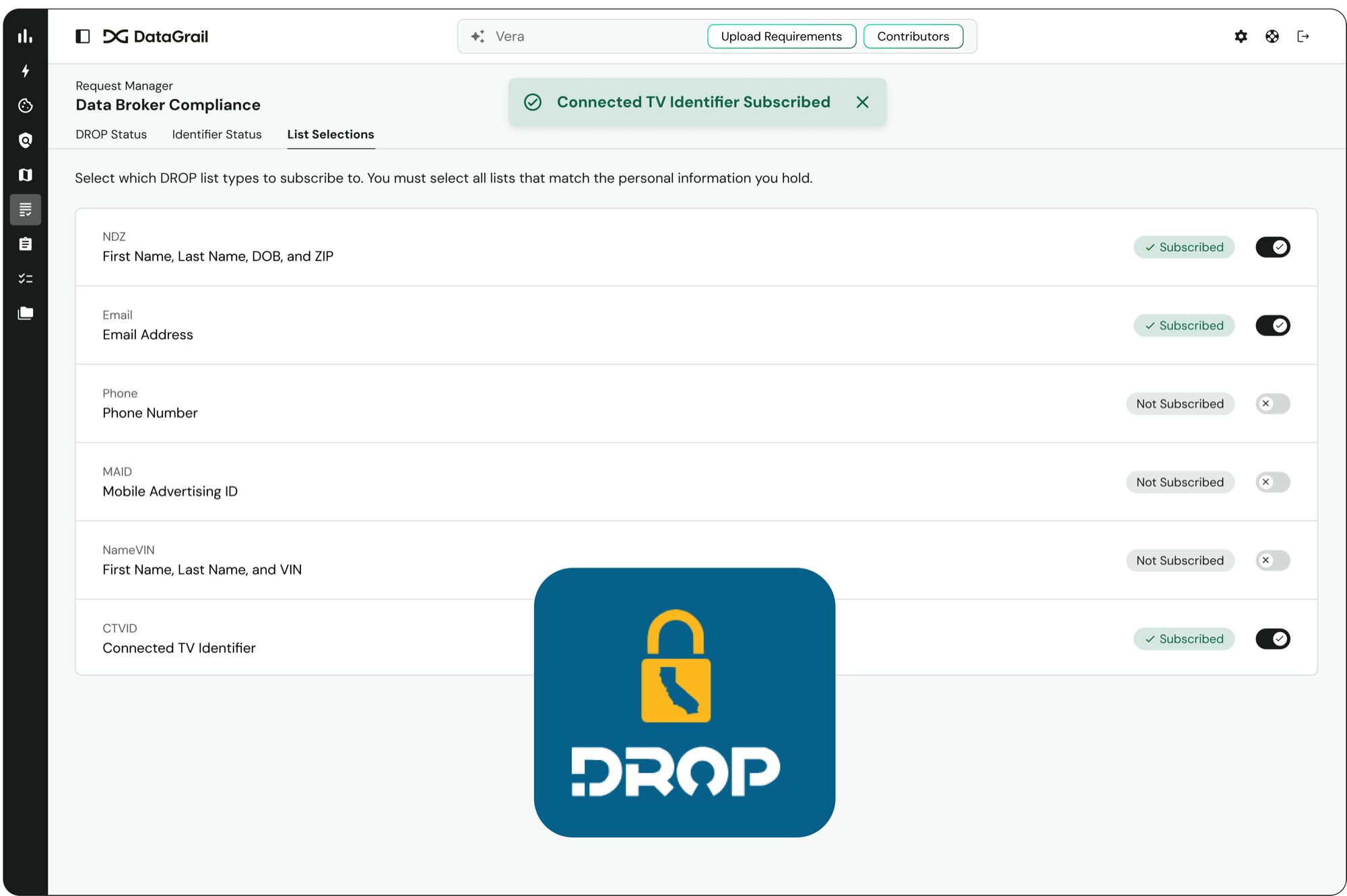
1. Integrate your DROP account and select your deletion lists
Integrate your DROP account in minutes. Subscribe to the DROP lists relevant to your business and DataGrail will automatically track the latest.
2. Securely hash and store your identifiers
Securely connect to your hashed identifier data source. DataGrail will automatically fetch and store hashed values in an encrypted vault. No PII is transferred.
3. Automate ongoing matching and deletion
Set DataGrail to continuously match and delete in-scope third-party data across all your connected systems while protecting your first-party customer records.
4. No-worry status reporting and monitoring
After deletions complete, DataGrail uploads status codes back to DROP, including amendments and new identifiers. Maintain complete visibility via a centralized dashboard.
How DataGrail stacks up
See how DataGrail compares to the rest of the market on what actually matters for compliance.
| Feature | DataGrail | Other privacy vendors |
|---|---|---|
| Integrations | 2,500+ integrations. No caps, no limits. | Limited integrations. Custom API work required. |
| Setup and deployment | No-code. Built for privacy managers, not engineers. | Significant engineering effort to configure and maintain. |
| Status reporting | Fully automated, every cycle, indefinitely. | Manual steps or custom scripts required. |
| §7613 direct data exemption | Applied automatically. First-party records preserved. | Manual configuration required, or not supported. |
| Security architecture | Single-tenant. Per-customer AWS keys. No raw PII stored. | Multi-tenant architectures common. Shared-environment risk. |
| Suppression list management | Hosted, automated, hashed identifiers only. | Limited or no cross-system identity resolution. |
| DROP automation | Full deletion and opt-out workflows and rules. | Dev workarounds. Ongoing opt-outs not automated. |
Built on the Complete Agentic Privacy Platform.
DataGrail Data Broker Compliance is built on the only complete privacy platform powered by a fully-integrated AI agent, 2,500+ in-house integrations, and a no-compromise security architecture.
Fully-integrated agentic AI
Vera, DataGrail’s secure, human-governed AI agent, delivers context-aware privacy guidance and task automation across your entire program, not just your DROP workflow. Scale your impact without adding headcount or sacrificing oversight.
No engineering degree required
A full suite of intuitive, low-code privacy automation products and 2,500+ integrations designed for non-technical privacy managers. Replace manual workflows and engineering bottlenecks across DSRs, consent, and now DROP compliance.
Always-on privacy visibility
Move from surveys and spreadsheets to a live, AI-powered Data Map. Power better RoPAs, evidence-based assessments, and always-on risk detection across your full data footprint, including the systems in scope for DROP.
Your partner from day 1 to day 1,001
Your named DataGrail expert supports onboarding, regulation readiness, and your long-term program goals. Whether you’re deploying DROP compliance ahead of August or maturing your privacy ops, your partner is with you every step.
Frequently asked questions
What is DROP, exactly?
DROP stands for Deletion Request and Opt-out Platform. It’s a California law (SB 362, the Delete Act) that creates a centralized portal where consumers can request deletion of their data from all registered data brokers at once. California publishes six distinct hashed deletion lists every 45 days, and registered data brokers must match, delete, and report back.
Does our existing DSR workflow cover DROP?
No. DROP is fundamentally different from a standard DSR. California acts as the intermediary, submitting batch deletion requests on behalf of consumers. Your existing DSR process handles consumer-initiated requests. DataGrail Data Broker Compliance is purpose-built for the DROP batch process and works alongside your existing DSR workflows.
What happens if we miss the August 1 deadline?
Penalties start at $200 per consumer per day with no cap. The CPPA has enforcement authority and has signaled it intends to use it. Given the volume of requests already submitted (250,000+), the exposure for non-compliant brokers compounds quickly.
Can we build DROP compliance in-house?
You can, but it’s a significant engineering project: DROP API integration, California’s exact hashing specification, matching logic, status reporting, and ongoing suppression list maintenance. DataGrail provides open-source libraries and a mock DROP server for teams that want to pre-hash, but most data brokers don’t want to own this workstream long-term.
How does DataGrail protect consumer data during the process?
DataGrail never stores PII in plaintext. All data is encrypted using a per-customer AWS key that never leaves AWS. Matching is hash-to-hash, so no actual names or emails are exchanged with California. If a customer offboards, DataGrail destroys their encryption key in one step, making all stored data permanently unreadable, including backups.
Our data is in 10+ different systems. Can DataGrail handle that?
This is exactly what DataGrail is built for. Data Broker Compliance connects to all your SaaS, cloud, and internal sources, reads identifiers from each, and the subject resolver handles whether the same person appearing in different systems should be treated as one deletion or multiple.
What if a DROP consumer is actually our own customer?
The §7613 exemption handles this automatically. Data collected through a direct first-party relationship — signups, purchases, direct subscriptions — is exempt from DROP deletion. You declare the §7613 status for each integration during setup, and DataGrail applies the exemption on every matching cycle.
We're not sure if we're a registered data broker. Can DataGrail help?
DataGrail can walk through the qualification criteria with your team, but cannot provide legal advice. The best path is for your legal or compliance team to review the California data broker definition against your business model. Common in-scope use cases include marketing and advertising data, people search, financial enrichment, location and mobile data, and identity resolution.
Additional resourcesLearn more about DROP and California privacy.
The Official Guide to CCPA
Guide. A comprehensive look at California privacy law obligations, enforcement priorities, and compliance strategy.
Read the guideDo Not Sell or Share Opt-Outs Guide
Guide. Everything privacy teams need to know about CCPA opt-out obligations, GPC signals, and compliant consent flows.
Read the guideCalifornia Privacy Law Overview
Interactive resource. A clear breakdown of California’s privacy regulatory landscape, including CCPA, CPRA, and the Delete Act.
Explore resourceDSRs by U.S. State Law
Research report. Data and trends on how DSR volumes are growing state-by-state, and what that means for teams scaling privacy operations.
View researchReady to automate your DROP compliance?
Enforcement begins August 1, 2026. Talk to a DataGrail expert and get DROP-ready before the deadline.