AI Privacy in Action: Managing 100s of Cookies In Minutes with DataGrail and Claude
Managing cookies at scale requires a level of human attention that few teams can afford to pay—and it’s costing them. DataGrail MCP + Claude is changing the game.
The consent management conundrum
Enterprise privacy teams know the biggest consent challenge isn’t keeping their banner updated, it’s managing everything that runs underneath it.
The operationally-intensive work of classifying errant cookies, updating tags after website changes, and babysitting a patchwork of historic rules isn’t just tedious, it’s high risk.
According to Gartner, U.S. states issued more privacy fines in 2025 than in the previous five years combined.
U.S. State Annual Privacy Fines
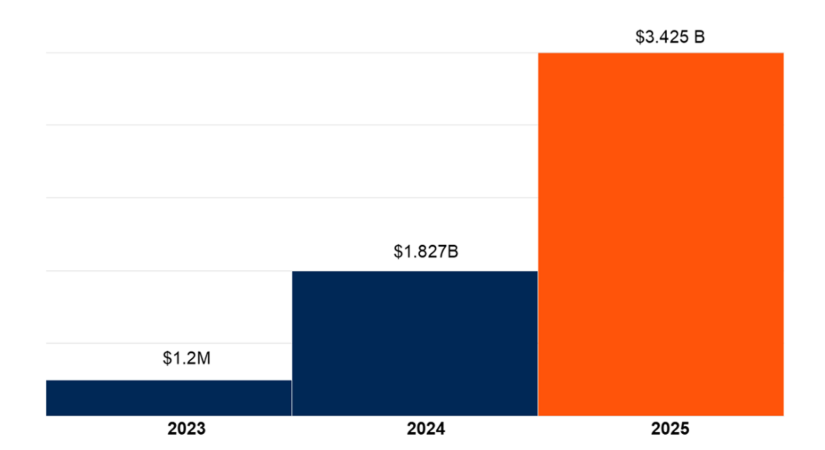
Source: Gartner (April 2026)
That’s in part because consent gaps are so easy for auditors to find, turning each stale cookie rule or unnoticed Hotjar script into an open invitation for an audit or CIPA claim.
The good news
The DataGrail Agentic Privacy Platform is already helping teams solve these challenges with fully-integrated, governed agentic AI.
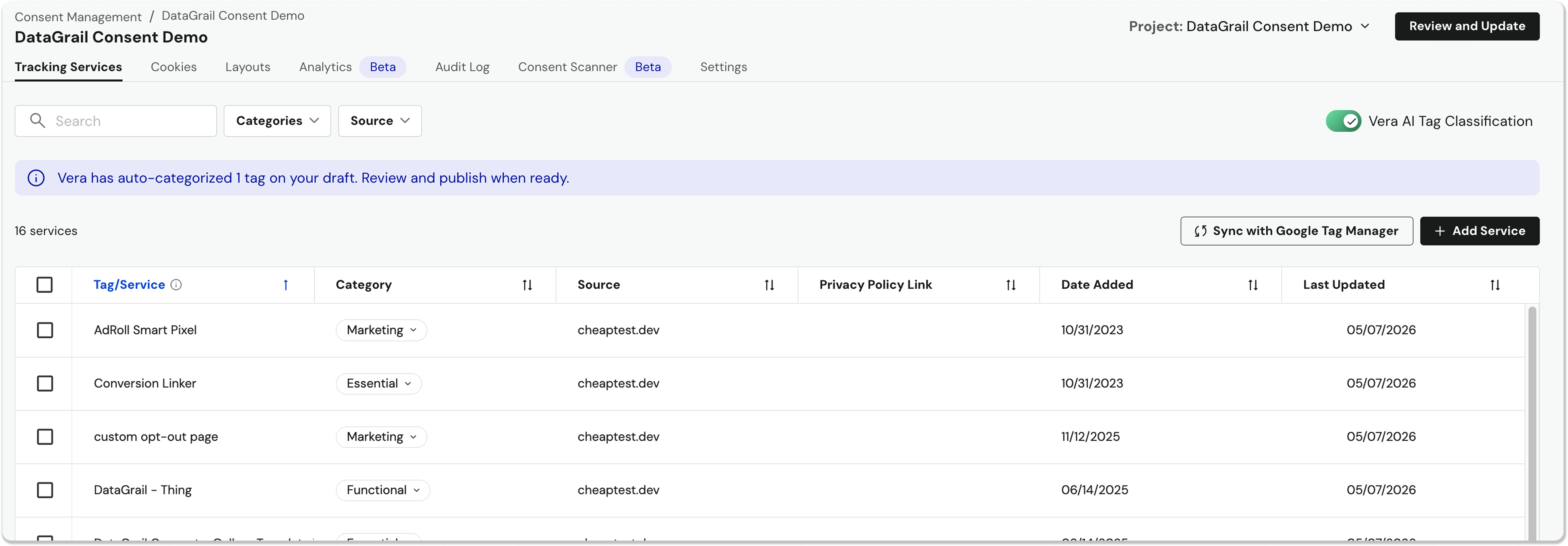
In this article, we’ll explore how easy it is for a single privacy manager to detect, classify, and update 100s of cookies in <5 minutes with DataGrail and Claude.
⚠️ Reader beware: once you see how powerful this is, you won’t want to touch a legacy CMP like OneTrust again.
Consent management, meet agentic AI
Savvy privacy teams are already exploring how to automate cookie management with the AI tools in their kits.
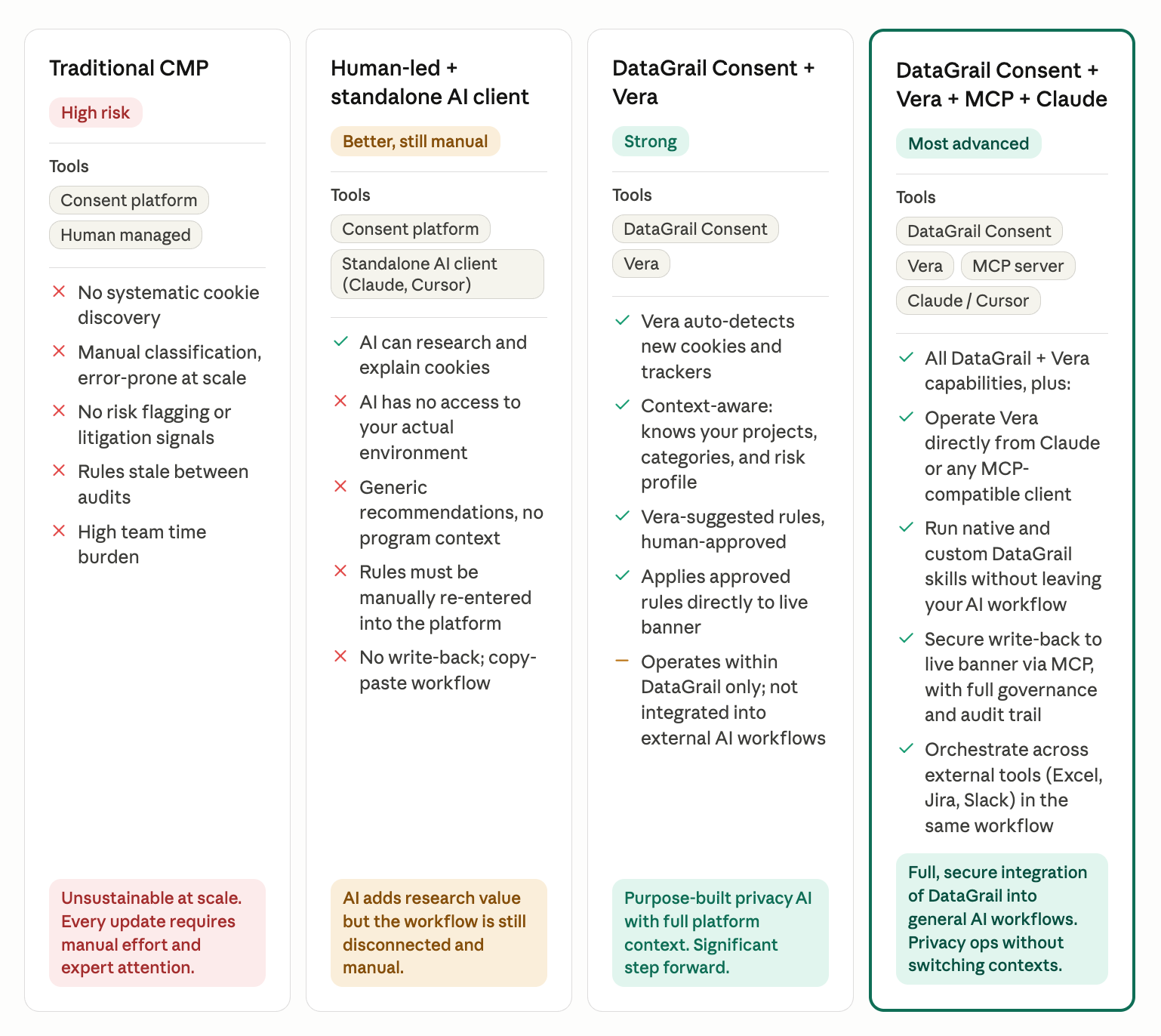
The typical breakdown happens because standalone AI clients like Claude or Cursor, while great at providing general insights, lack the context needed to make recommendations tailored to the reality of your consent program—not to mention a secure way to apply them.
While the added AI research is a welcome improvement, a human still ultimately has to translate and manually apply it back to the CMP.
Some privacy tools have added bolted-on copilots that provide recommendations with some more contextual awareness. Helpful, but copilots alone lack the ability to make governed updates. And your team is still on the hook to apply the updates manually.
Addressing the primary consent challenge—proactively keeping up with a rapidly evolving consent landscape—requires a more elegant solution.
The DataGrail Solution: Automated Consent Management + integrated AI agent + MCP.
Our unique approach is sophisticated enough for enterprise privacy teams to operate at scale, and simple enough for any privacy owner to manage—no coding, no prompt engineering, and no dev tickets.
DataGrail Consent provides continuous up-to-date consent policy management, while Vera—your fully-integrated privacy AI agent—tracks changes and recommends updates. When you’re ready to take action, the DataGrail MCP server uses human-approved write-back to update a single cookie classification, or apply new rules globally across your program.
And it’s all built on a no-compromise security platform with granular admin controls, audit logs, and a single-tenant architecture.
In short, DataGrail is wired for end-to-end AI consent management in a way that general-purpose AI assistants and bolted-on chatbots are not.
Let Vera stay on top of your cookies
Vera has the context, integration, and human-governed oversight to operate as a full-time member of your team, able to:
- Understand your consent program top to bottom
- Automatically detect new cookies on your sites and recommend classifications and rules
- Handle the full cookie lifecycle end to end with human-approved actions.
- Optionally integrate with AI clients like Claude
Because Vera operates natively in DataGrail Consent, it has full context on your consent environment, including projects, containers, and categories.
☝️This context is what separates agentic consent management from AI-assisted research.
No need to navigate the platform to find where a rule lives. Just tell Vera what you want, and Vera resolves the right project, container, and consent category automatically.
Working in Claude with the DataGrail MCP Server
If you’re already working in an AI client like Claude or Cursor, connecting DataGrail is code-free, secure, and takes less than 10 minutes. From there, you’ll have access to a wide range of Vera AI capabilities directly in your AI workflows.
Claude + DataGrail cookie management workflow example
Let’s start with a simple prompt: “Pull a list of all unmanaged cookies in our environment.”
Claude automatically calls Vera to kick off the work, returning — in this case — 131 unmanaged cookies organized by risk level, with contextual flags on anything that warrants attention.
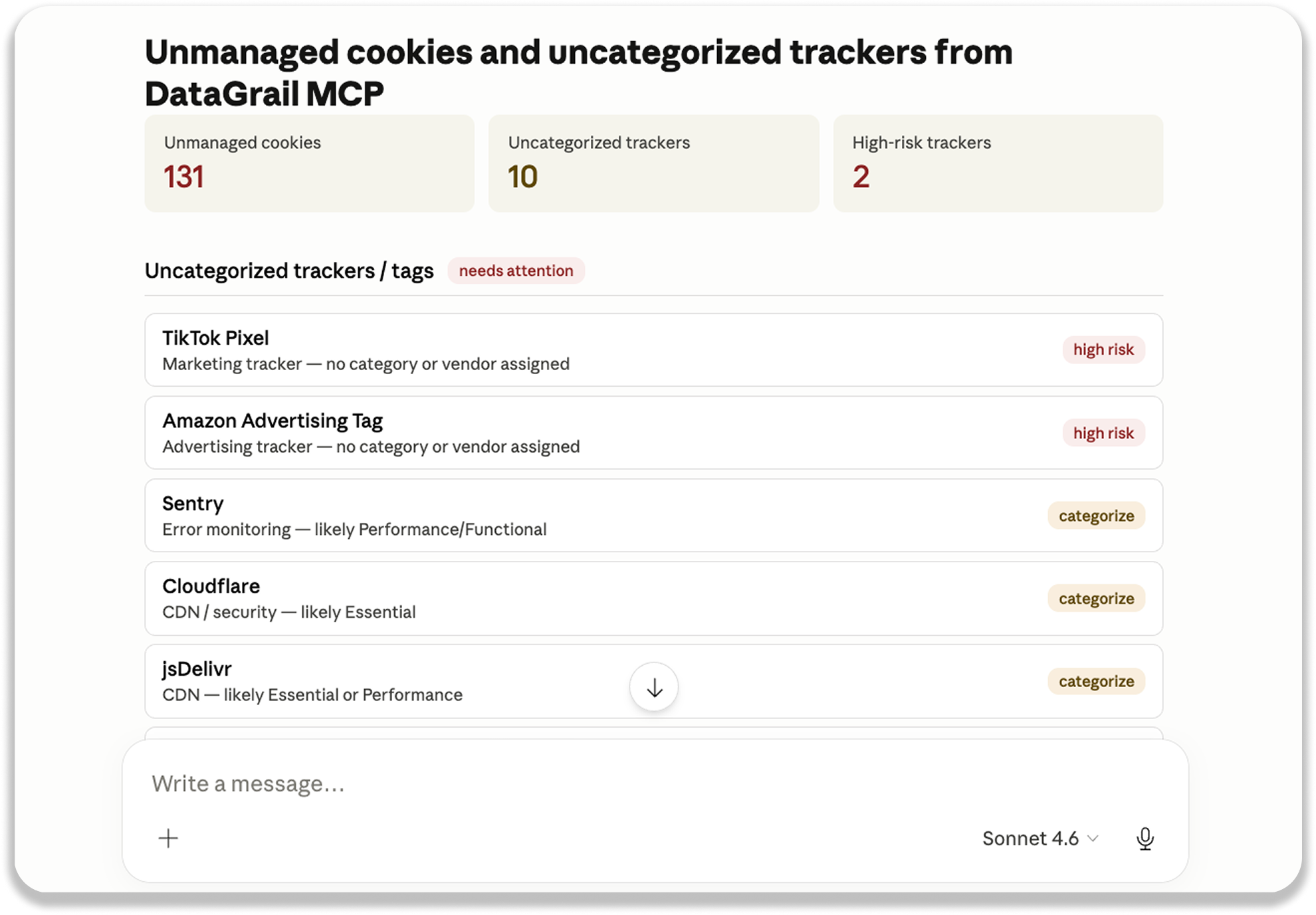
Note that it surfaced a Hotjar cookie, with a flag about its history in CIPA-related litigation.
☝️That’s the kind of signal that typically takes a privacy analyst meaningful time to surface manually.
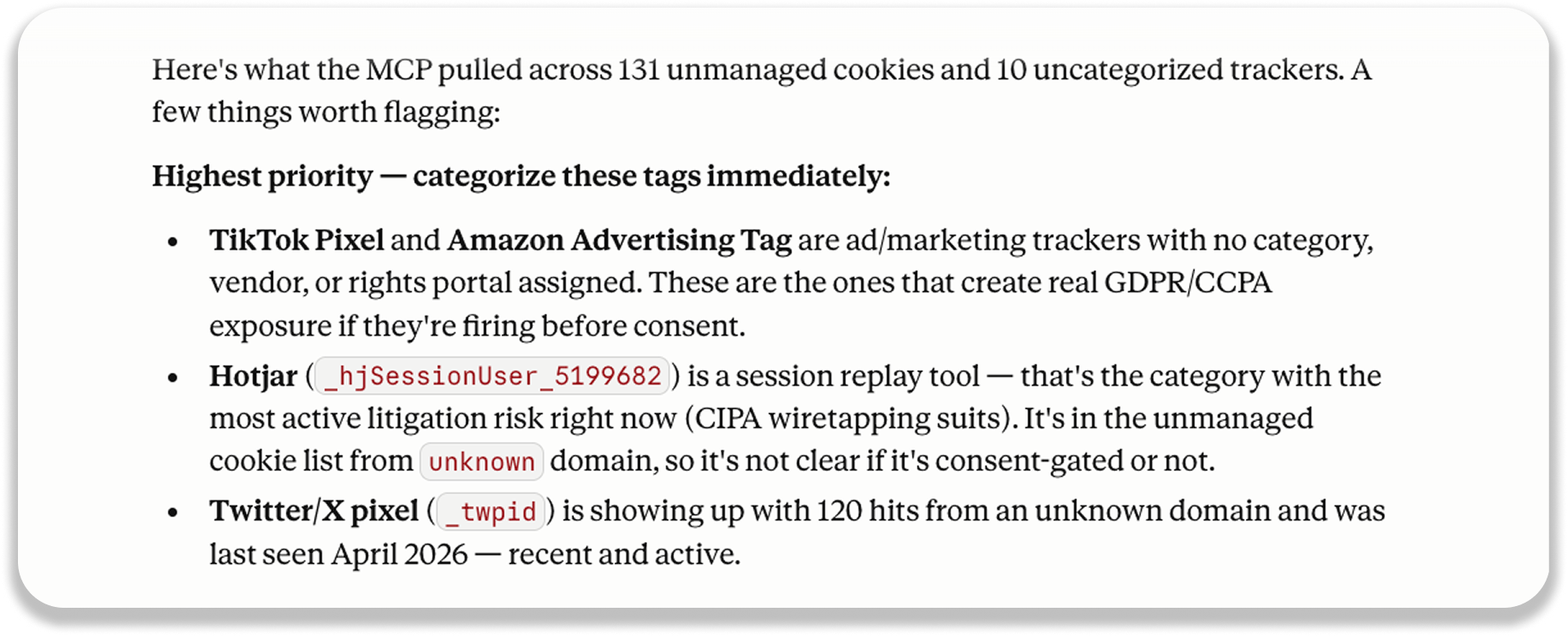
From there, you can prompt Claude to “suggest classification rules for those unmanaged items.”
It returns 40 suggested rules organized by consent category — essential, analytics, advertising — based on your actual environment, not generic best-practice defaults.
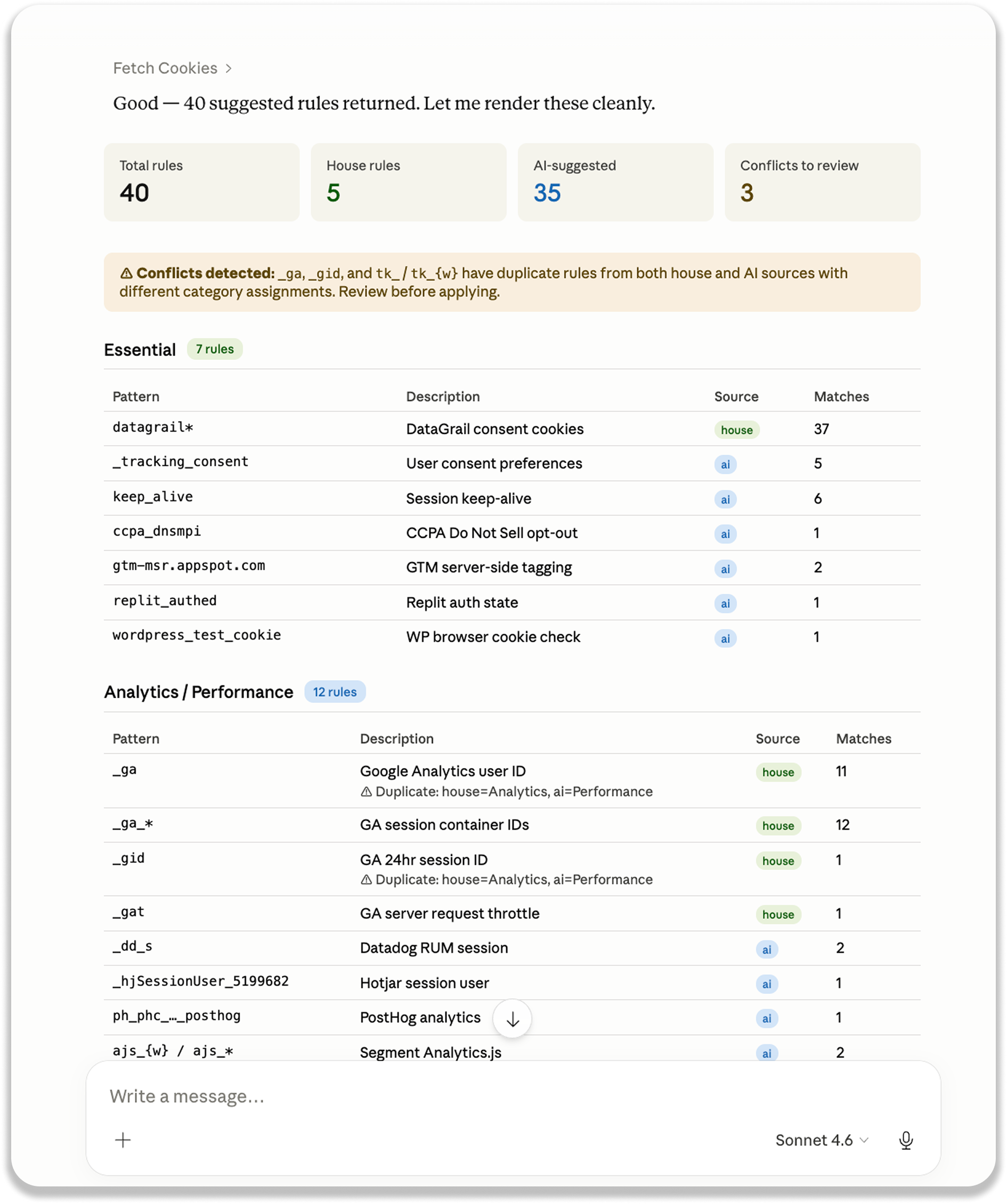
Here’s where MCP write actions truly make the difference.
Instead of leaving Claude to go approve each rule inside DataGrail (or figure out how to apply them manually if you were using a legacy CMP like OneTrust) you can simply review the suggested essential trackers right in Claude, approve them, and Vera will update the rules in DataGrail and push to the live consent banner — all in real time.
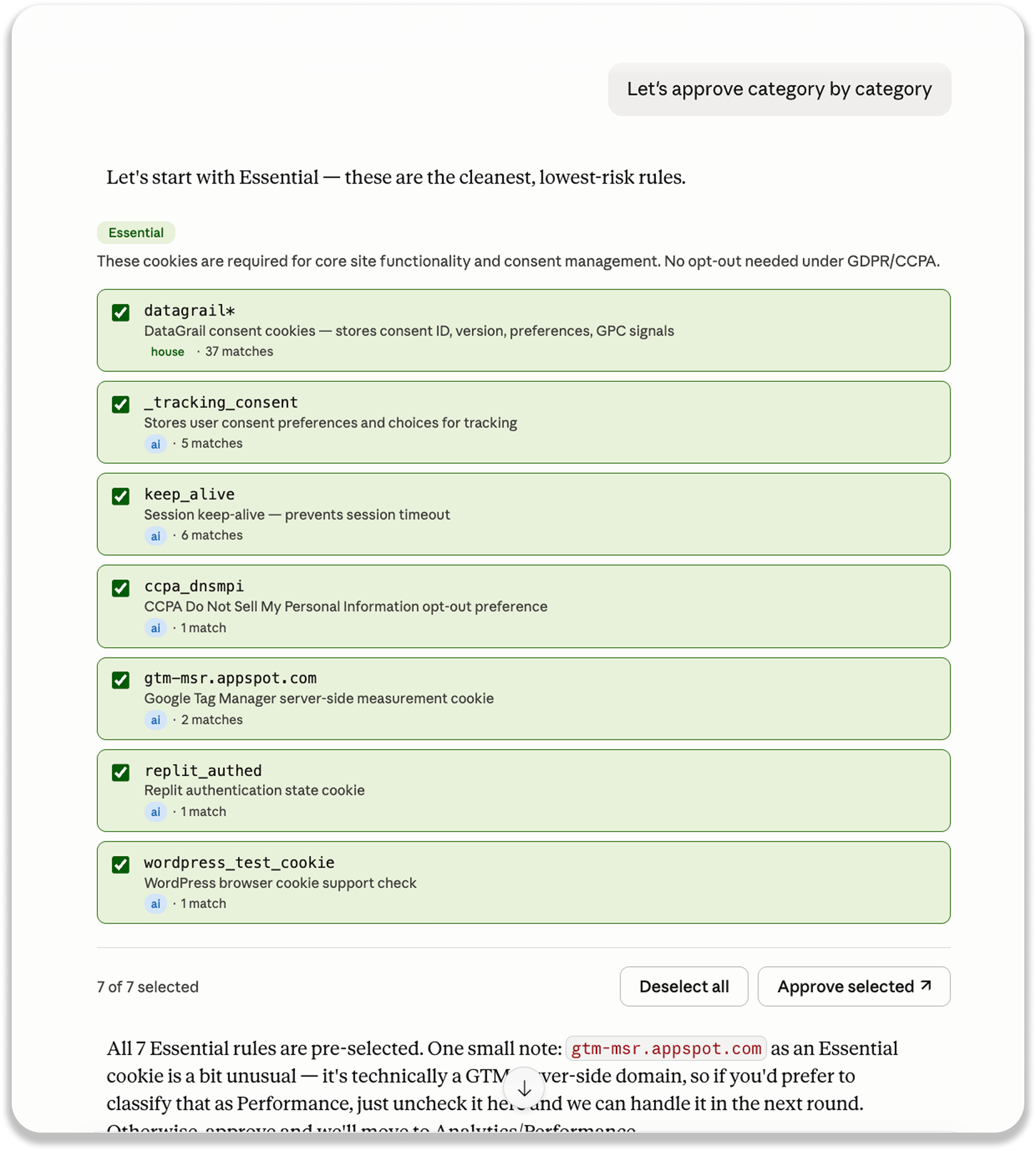
The entire workflow happens in minutes, without switching tools. The consent configuration changes, and the banner updates to reflect it.
From there, you could also choose to kick off additional workflows with other MCP-enabled tools. For instance—tell Claude to create a Jira ticket to track the Hotjar issue resolution workflow.
Who should use DataGrail + Claude?
Everyone! The DataGrail MCP Server is included for all DataGrail customers with read actions only enabled by default, and write actions available with admin approval.
This cookie management use case offers the highest value for privacy managers managing multiple properties, frequent stack changes, or significant volumes of third-party tags.
Consent management is one of the most operationally intensive areas in a modern privacy program. Rules accumulate. Tech stacks change. New trackers appear. Regulations evolve. What worked at your last audit may not reflect what’s actually running on your site today. DataGrail + Vera + MCP changes the math and finally gives resource-strapped teams the power to stay on top of it.
Built on a no-compromise security architecture
One question that comes up when teams hear “agent writing to our consent configuration” is, understandably, security. Vera operates on DataGrail’s no-compromise platform architecture: single-tenant infrastructure, human-governed task execution, and an MCP integration that requires explicit approval before any changes are applied.
Nothing writes to your configuration without a human in the loop. As an added governance layer, DataGrail admins can apply granular MCP read and write permissions for every user, and every system.
That’s not just a guardrail, it’s the foundation. The goal isn’t fully autonomous consent management. The goal is making it fast and easy for an empowered privacy manager to apply the right updates at scale.
Building the future of agentic privacy operations
This kind of powerful, intelligent, and governed automation has been a long time coming for privacy operations teams.
The ability to direct a privacy AI agent with plain language and have it execute against a live platform is a true shift. Not just in efficiency, but in the types of expertise a privacy team can actually apply day to day. Less time digging through configuration interfaces. More time on decisions that require human judgment.
DataGrail created the Vera privacy AI agent, the integration network, and the consent platform purpose-built for this kind of work.
The MCP write capabilities for cookie rules and categorization are available now.
This is where privacy operations are headed. We’re proud to partner with the best privacy teams in the world to lead the way.
See how DataGrail powers consent management →
Questions about connecting DataGrail’s MCP server to your AI client? Talk to your DataGrail team.