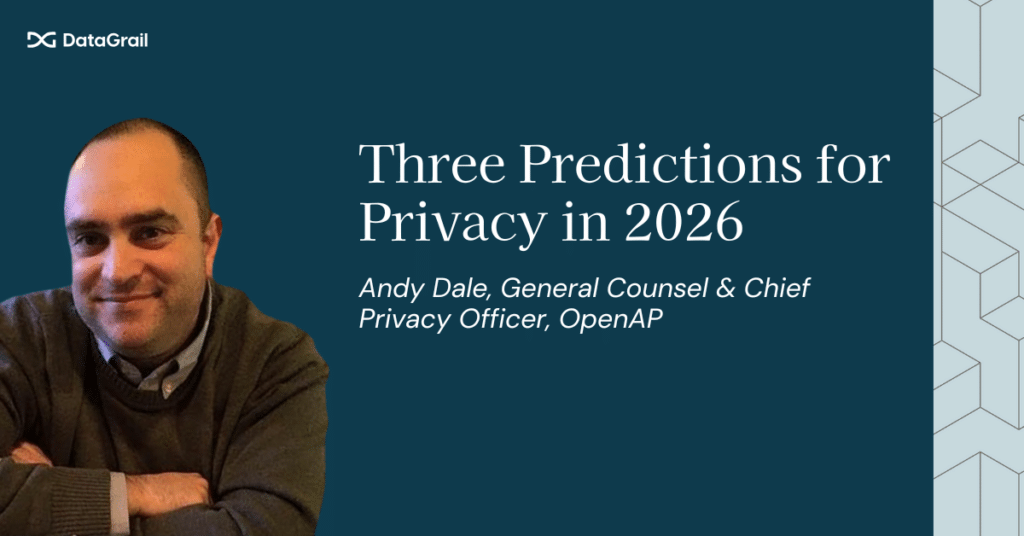
Our 2026 predictions series invites privacy leaders to reflect on what’s in store for 2026. This post was guest written by Andy Dale (General Counsel & Chief Privacy Officer, OpenAP). Also check out predictions by Daniel Barber and Steve Lappenbusch.
Ten years after GDPR went into effect, it’s clear that privacy is an operating discipline that requires significant development of a fully independent function. Privacy teams today are carrying expanding responsibility across regulation, litigation, enforcement, and AI—often without a corresponding increase in resources or bandwidth. There’s no sugarcoating it: 2026 will not be an easy year for anyone working in privacy, especially as more US States enact legislation and enforcement picks up.
Here are a few predictions for privacy work in 2026.
1. Privacy teams will move closer to Product—by necessity
In tech companies, product counseling is the highest-value work a lawyer can do. The most durable compliance and innovation strategy is not better documentation or faster response times—it’s building products, go-to-market motions, and data practices that assume scrutiny from day one and build based on considered and weighed risk/reward ratios.
Until organizations internalize this, privacy teams will remain stuck in a reactive posture—managing risk after decisions have already been made. That is a losing game. It starts with Product.
As regulatory frameworks grow more complex and U.S. state enforcement ramps up, successful privacy lawyers will spend more time upstream: helping product teams make defensible, durable decisions in dynamic environments.
2. Privacy teams will stop fearing AI and start using it
It wasn’t clear where in the legal department AI oversight might fall. Early thinking was that privacy teams may be well suited. I think we are seeing that come to fruition.
General Counsel and privacy leaders will use AI in 2026 more than ever. AI is making lawyers more efficient. The lawyers who grab ahold and learn the tools will win. Using AI tools to review contracts faster, redline NDAs in minutes, recall historical positions, and pressure-test assumptions at scale is THE play in 2026. Teams that embrace these tools will become materially more valuable.
At the same time, internal business partners are 10x’ing their AI use cases and these tools will be embedded across nearly every area. To remain effective and relevant privacy professionals/lawyers will need a working, technical understanding of how these systems operate—and how to guide their responsible use. This goes beyond governance or ideas – become an expert.
AI isn’t taking the lawyer’s job if you don’t let it. Ignoring it, however, might.
3. Privacy will become a core career chapter for future GCs
Privacy work sits at the intersection of regulation, technology, and cross-functional execution. The best privacy leaders don’t frame their work solely as risk mitigation—they translate it into commercial terms the business understands. They unlock innovation by helping teams move forward with confidence, not by defaulting to “no.”
That combination of skills—legal judgment, technical fluency, and business partnership—maps directly to what modern General Counsel roles require.
More than almost any other legal background, privacy experience prepares lawyers to handle enterprise-level decision-making. In 2026 and beyond, I expect to see privacy experience explicitly called out as a preferred—or perhaps even a required—qualification in GC searches.
It is an exciting time to work in privacy. The challenges ahead are real, but so is the opportunity.
Andy Dale is the General Counsel & Chief Privacy Officer at OpenAP. Find him on LinkedIn.
The opinions expressed in this article are solely those of the author and do not necessarily reflect the views of DataGrail.